Short answer: Before buying a plaza, a shop or a commercial plot in Bahria Enclave, run 14 checks: is the plot inside the approved 12,543-kanal layout, does the building have its final NOC, who holds title to a shop, and does the rent claim survive a lease and bank statements. Asking-price evidence from 2 October 2026 points to a gross yield of 3.8 to 5.6%, not the 6 to 9% some blogs quote.
Direct line: Muhammad Hasnain, plot specialist for Bahria Enclave & DHA Margalla Enclave — WhatsApp 0300 0399322. Verified before you pay; drawbacks in writing.
"Commercial in Bahria Enclave" is three different purchases. A bare commercial plot, a finished plaza or shop, and a floor or shop in a plaza still being built carry different risks. The checks below say which product each one applies to, what to ask for, why it matters, and what a red flag looks like. The "why" is tied to Bahria Town's own 2023-24 building SOP, so you can verify it rather than take my word.
Context: on 25 September 2026 CDA wrote about Bahria Enclave-I's layout and building plans, and directed IESCO and SNGPL to connect utilities only in line with the approved layout and sanctioned building plans (The Nation and Daily Times, 25 September 2026). That raises the value of checks 1 and 2 below. See the CDA action page.
Part 1: Is the land and the building legitimate?
1. The plot is inside the approved layout (all three products)
Ask for: the plot number and sector, then check it against the approved LOP map.
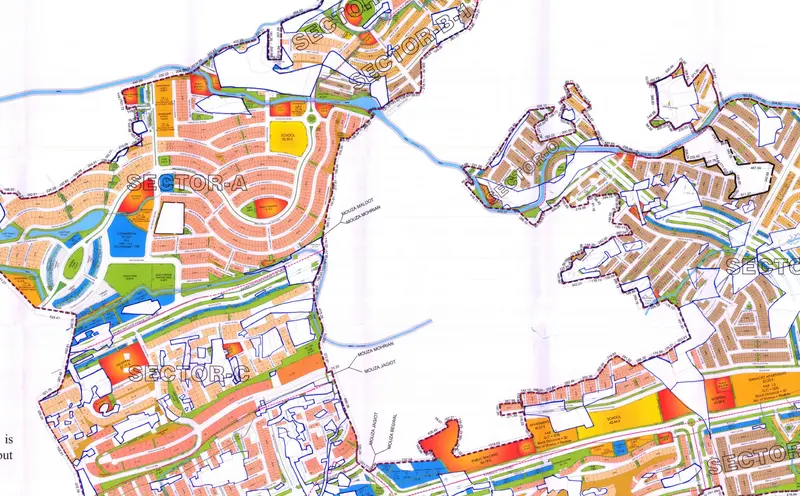
Why: CDA's approved layout for Bahria Enclave-I is 12,543 kanals (approved December 2020). CDA's letter alleges that land reserved for a park under that layout was converted to commercial use, and that the scheme was extended past 18,000 kanals without a revised layout. Whether any particular plot is affected is exactly what a plot number check answers.
Red flag: the seller cannot give a plot number, or says "the whole sector is fine" without a map reference.
2. Utility connections exist, and are sanctioned (finished and under-construction)
Ask for: the latest electricity bill, the gas and sewerage status, and the utility NOC forms.
Why: the SOP's final NOC (pages 88-89) requires utility NOC forms for electricity, gas and sewerage. CDA's direction means connections should follow sanctioned plans. A building running on a temporary or construction connection is not the same thing.
Red flag: "the connection is coming", or a bill in a name that is not the owner's.
3. The possession letter and its date (bare plot)
Ask for: the first possession letter, not a photocopy of a transfer.
Why: clause 12.16 (page 134) of the SOP requires construction to start within three years of the first possession letter, with possible non-utilization fee or cancellation. The clock may already be running when you buy.
Red flag: no possession letter, or a seller who avoids saying when it was issued.
4. Floor count confirmed in writing (bare plot, under-construction)
Ask for: a written confirmation from the Design Wing of the floors allowed on that plot.
Why: the SOP's page-79 row for Bahria Enclave 30x40 and 40x45 commercial plots reads L.G+G+3 at 100% coverage, while the fee table uses B+G+3 and B+G+4 headings. A dealer's "five floors" or "six floors" needs a paper behind it. Our commercial building rules page explains the difference.
Red flag: a floor count that comes only from the seller or a brochure.
5. Approved design and fixed elevation (under-construction)
Ask for: the approved drawings and the elevation approval.
Why: clause 5.21.2 says elevations are fixed for all commercial areas. If what is being built differs from the approved drawing, the façade sign-off needed for the final NOC (page 88-89) is at risk.
Red flag: extra floors or a changed façade versus the approval.
Part 2: Is the building complete and signed off?
6. Final NOC to occupy (finished plaza)
Ask for: the final NOC itself, and the completion certificates behind it.
Why: the SOP lists a structural completion certificate, fire-fighting and MEP certificates, utility NOCs, signed inspection cards, façade sign-off, a No Demand Certificate and the final NOC fee. A plaza already trading without them is trading on risk.
Red flag: "NOC in process" on a building with tenants already inside.
7. Fire-fighting completion certificate (finished and under-construction)
Ask for: the fire-fighting certificate for the whole building.
Why: the SOP allows a floor to receive provisional completion only if the exterior is finished and fire-fighting for the whole plaza is operational. A floor you buy cannot be cleared independently of the building's safety systems.
Red flag: your floor is finished but the building's fire system is not.
8. Per-floor provisional completion (under-construction)
Ask for: in writing, which floors have provisional completion today and what the developer must still finish before yours qualifies.
Why: provisional completion is the only route to occupying one floor before the whole plaza is done.
Red flag: a handover date with no mention of completion certificates.
9. No Demand Certificate (all three)
Ask for: a No Demand Certificate in the seller's name, current to the date of sale.
Why: the SOP's final NOC list includes it, and it is the clearest proof that the seller has paid what the society claims. Read our transfer fee page for what else the society charges.
Red flag: the buyer is asked to "pay the dues later".
10. Construction quality and cost realism (under-construction)
Ask for: the contractor's name, the stage of work and what the price includes.
Why: the SOP says (5.21.10) there are no approved contractors of Bahria Town, so nobody is vouching for the builder. Bahria Town also does not take responsibility for soil, structural or MEP design. Compare the developer's claims with our construction cost bands.
Red flag: a price per square foot well below what finishing the building would cost.
Part 3: Who owns what you are paying for?
11. Title for a shop or floor in a plaza (shop and floor buyers)
Ask in writing: "In what form will I hold this shop, and what document proves it?" Ask whether it is a sub-lease, a share, or something else, who the registered owner of the whole plaza is, and whether the plot is mortgaged.
Why: the arrangement for a unit inside a larger building is not the same as owning a plot. I will not guess it for you; the answer must come from the documents and a lawyer's reading of them.
Red flag: a verbal promise that "the papers will be done after the building is complete".
12. Tax filer status and total cost to transfer (all three)
Ask for: both parties' filer status before you agree a price.
Why: the Finance Act 2026 sets filer rates of 2.75% for the seller (section 236C) and 1.25% for the buyer (section 236K). Non-filer treatment differs; see taxes and transfer costs rather than a dealer's figure. The cost to transfer changes your real yield.
Red flag: a seller who suggests recording a lower price.
Part 4: Does the rent claim survive scrutiny?
13. A rent claim backed by paper (finished plaza and shop)
Ask for: the lease, three to six months of bank statements showing rent received, the tenant's identity, and the lease end date.
Why: a rented shop is priced on its rent. If the rent is not real, the price is not either.
Red flag: cash rent with no trail, a tenant who is a relative of the seller, or a "bank lease" with no document.
14. Yield sanity check (all three)
Ask for: the asking price and the stated rent. Divide annual rent by price.
Why: on 2 October 2026 we looked at Zameen.com listings that state a current rent. These were asking prices from a page-one sample. Five gave gross yields from 3.8% to 5.6%: a Sector H shop of 500 sq ft at Rs 95 lakh with Rs 30,000 rent (3.79%), and a Sector A 4 Marla plaza at Rs 9.5 crore with Rs 425,000 rent (5.37%) are the two ends of what we found. Blogs that claim 6 to 9% cite no lease data. Full workings are on the rental yield page. The SBP policy rate stood at 11.5% after its 14 September 2026 decision, so compare any gross yield with what money earns elsewhere before costs.
Red flag: a promised yield above the band with no lease behind it.
Which checks apply to which product
| Product | Checks that matter most |
|---|
| Bare commercial plot | 1, 3, 4, 9, 12 |
| Finished plaza or shop | 1, 2, 6, 7, 9, 11, 12, 13, 14 |
| Floor or shop in an under-construction plaza | 1, 2, 4, 5, 7, 8, 10, 11, 12 |
For the plot-level price picture, see the commercial plots hub. For the general paperwork habit that applies to every purchase, read verify before you pay.
What we do
Send me the plot number, the seller's documents and the advertised rent on WhatsApp 0300 0399322. I check the file against the approved layout and the SOP list above, and send back the drawbacks in writing, including the ones that make a deal less attractive. I do not promise returns, and I will tell you if the honest answer is to walk away.
Figures are from Bahria Town's 2023-24 SOP (a newer revision may exist), the Finance Act 2026, news reports dated 25 September 2026, and a Zameen.com page-one sample of asking prices on 2 October 2026. This is not legal or tax advice.